USB Firmware Compilation
Connect to Host
The Fly-D8 motherboard can only communicate with the host via the Type-C USB interface for Klipper.
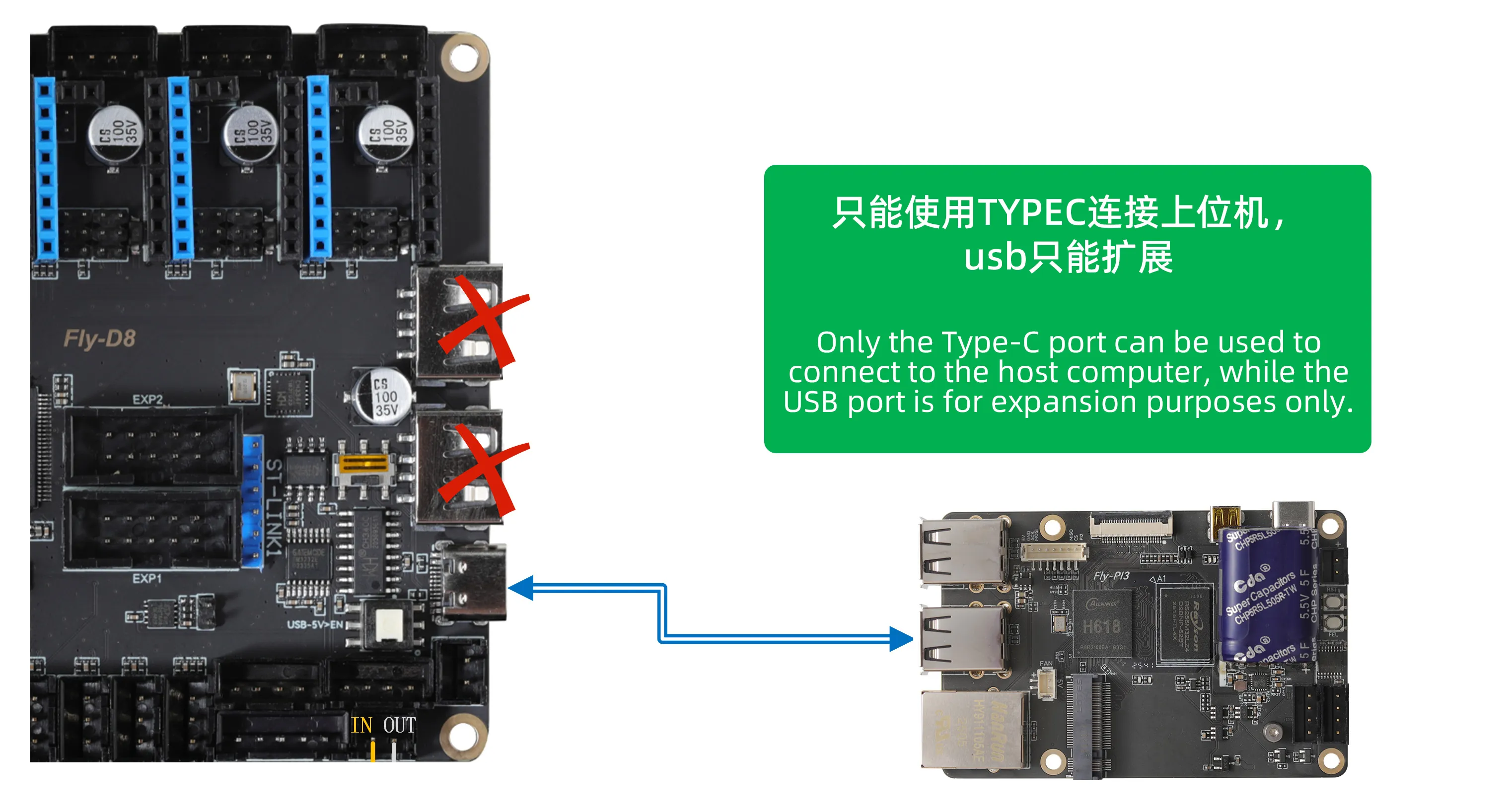
Firmware Compilation Notes and Operation Guide
Notes
- Network Connection: Ensure the host machine (Raspberry Pi, etc.) is connected to the network.
- Access Method: You must log in to the host machine via SSH over the network. Using serial port tools is prohibited.
- User Permissions: Use the correct user account for operations based on the host machine's system type.
- Input Method: Ensure the keyboard input method is set to Half-width mode (English mode).
SSH Login and User Switching
SSH Login to Host Machine
Use an SSH tool (such as MobaXterm, PuTTY, etc.) to log in to the host machine over the network: View Detailed SSH Connection Tutorial
Switching Users Based on System Type
- Standard Host Machine (Armbian)
- FAST System (FlyOS-FAST)
Applicable Systems:
- Official Raspberry Pi OS
- FLY Pi Armbian System
- Other systems with Klipper installed
User Permission Requirements:
- Do not use the
rootuser for any operations. - You must switch to a standard user for operations.
Switch Command:
-
Other systems (replace
<username>with your username)su <username>
Standard users typically have the necessary compilation permissions. Using the root user may cause permission issues.
Applicable Systems:
- FlyOS-FAST System
Login Information:
- Username:
root - Password:
mellow
The FAST system only has the root user.
Firmware Compilation Instructions
1. Keyboard Operation Guide
- On the Klipper firmware configuration page, you can only use the following shortcut keys:
- You cannot use the mouse directly!
| Key | Function Description |
|---|---|
| ↑ ↓ Arrow Keys | Move the cursor up/down to select menu items. |
| Enter or Space | Confirm selection/check menu item or enter submenu. |
| ESC | Return to the previous menu level. |
| Q | Exit the Klipper firmware configuration page. |
| Y | When prompted upon exit, press Y to save the configuration. |
Show Hidden Options
If there are few options on the configuration page, first check:
[ ] Enable extra low-level configuration options
This option is used to display some hidden configuration options.
Start Firmware Compilation
The following describes how to compile the firmware:
-
After connecting via SSH, enter the following command and press Enter:
cd ~/klipper && rm -rf ~/klipper/.config && rm -rf ~/klipper/out && make menuconfig -
Among these,
rm -rf ~/klipper/.config && rm -rf ~/klipper/outdeletes previous compilation data and firmware. -
make menuconfigis for compiling the firmware. After execution, the following interface should appear: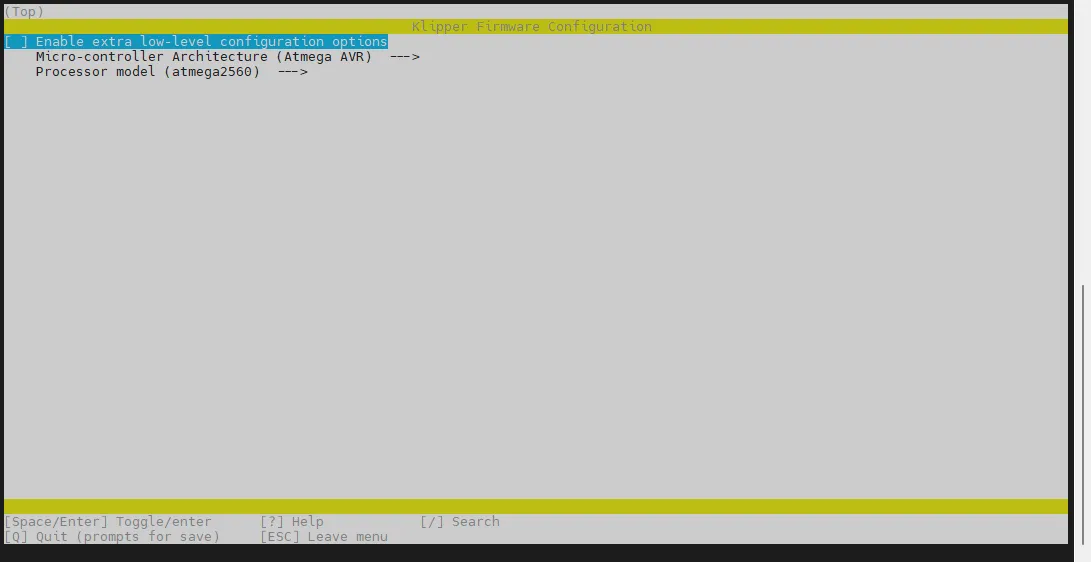
-
Select Enable extra low-level configuration options and press Enter.
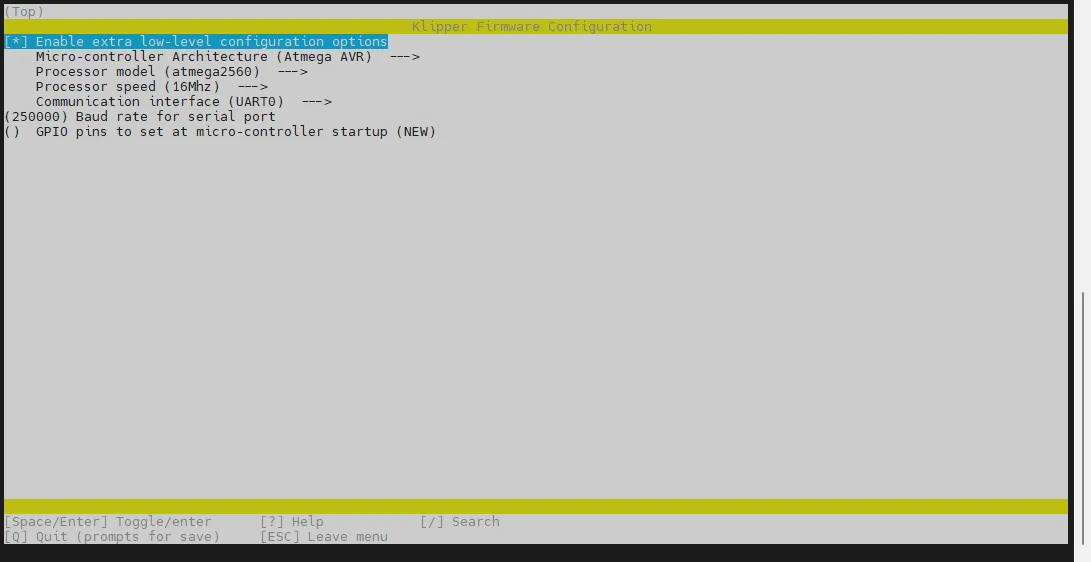
-
Navigate to the Micro-controller Architecture menu, then select STMicroelectronics STM32 and press Enter.
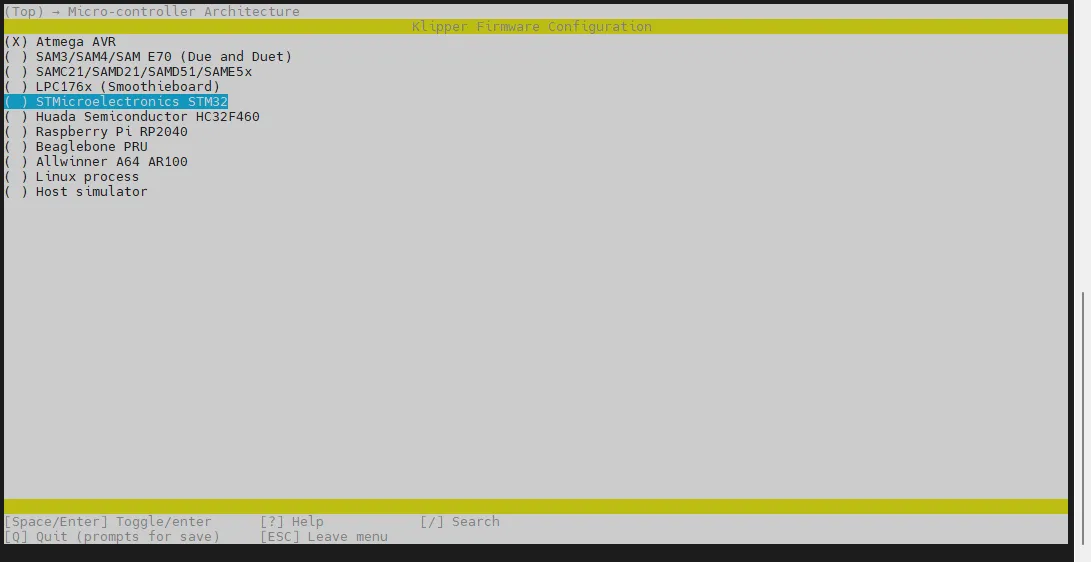
-
Navigate to the Processor model menu, select STM32F407, and press Enter.
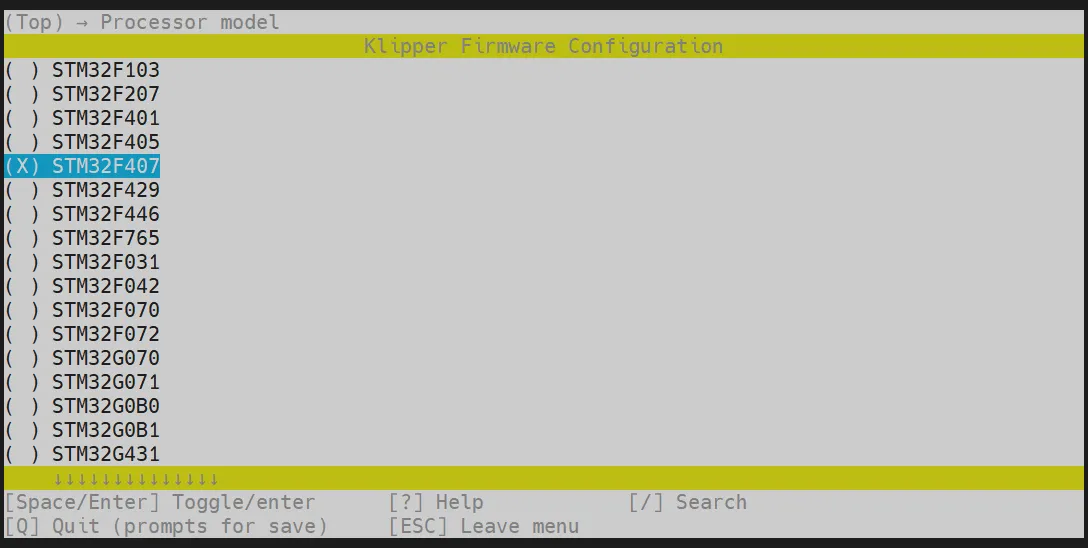
-
Select Bootloader offset, and choose: 32KiB bootloader.
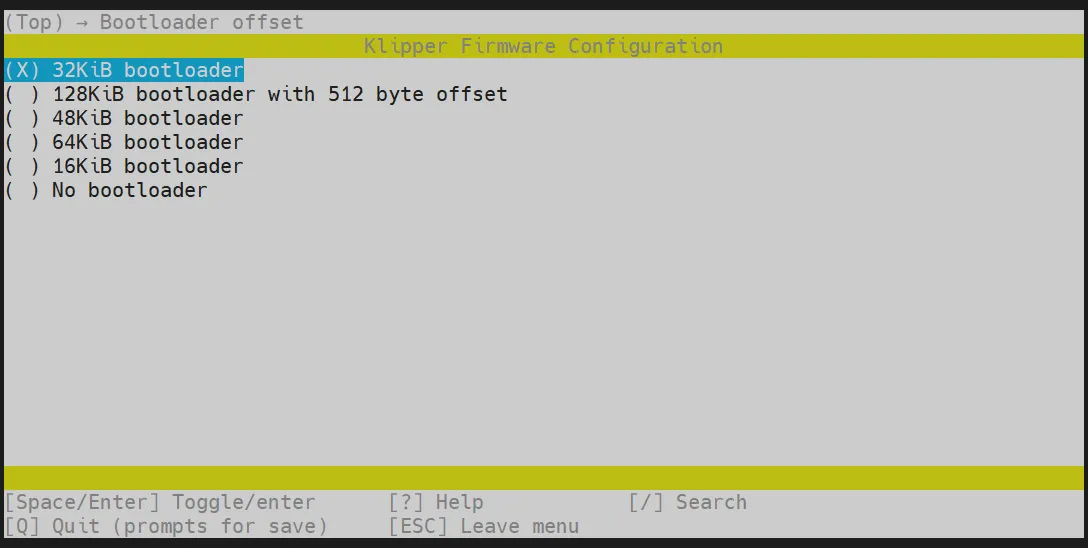
-
For Communication interface, select: USB (on PA11/PA12).
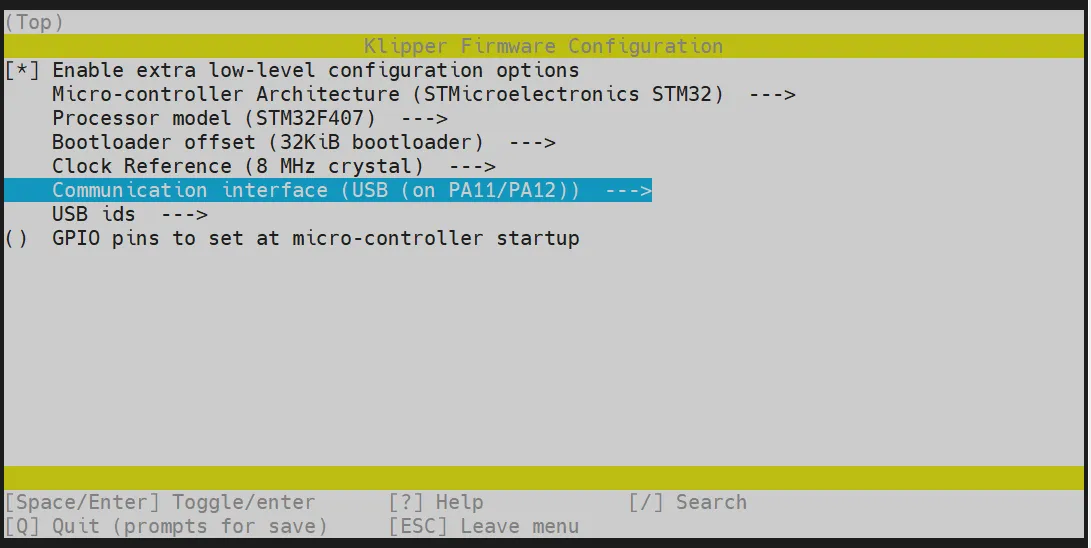
- Press the
Qkey. When Save configuration appears, press theYkey.
- The configuration should now be saved, and you will exit back to the command line interface.
- Enter the following command to start compilation. This will take some time.
make -j4
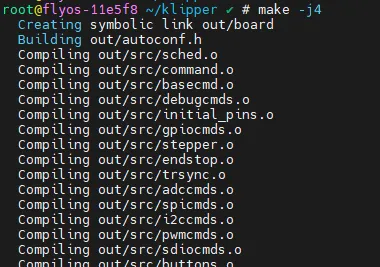
- If the following content is output at the end, the compilation is successful.
- Due to Klipper version differences, as long as
out/klipper.binappears, it indicates success.Linking out/klipper.elf
Creating bin file out/klipper.bin
Enter Flashing Mode
- After connecting the motherboard to the host using a Type-C data cable, double-click the RST button. At this point, the LED on the motherboard will flash.
- If the LED does not flash, please re-flash the katapult firmware: Flash katapult firmware
- If the LED does not flash, after flashing the katapult firmware, proceed to the next step.
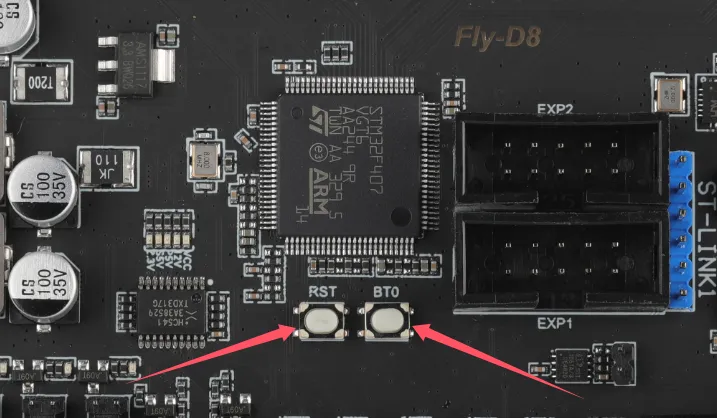
- Please ensure that the host machine can connect to the network normally and ensure that the data cable connecting the lower-level machine to the host machine has data transmission function.
- After SSH connecting to the host machine, input
lsusband press Enter. If the information circled in the following picture appears, you can proceed to the next step.- If there is no feedback at all, this is a system problem of the host machine, and we are unable to help. You need to replace with a confirmed normal system or replace the host machine.
- If the prompt says there is no
lsusbcommand, you can execute the following command to install it:sudo apt-get install usbutils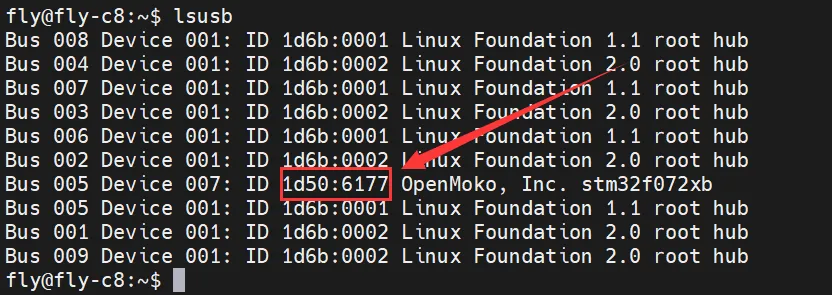
1d50:6177belongs to the device you will use this time.- Some host machines may not fully display or fail to display due to system problems.
- If the
lsusbcommand can display the device but does not show1d50:6177, please try replacing the data cable and connecting the mainboard to another USB port on the host machine.
- If you have executed the above steps before and successfully burned the Klipper firmware, and the mainboard is running normally, but you just want to update the Klipper firmware, please directly check the
Firmware Updatesection in the right menu bar of this page.
You must query the 1d50:6177 device before proceeding to the next step.
Flash Firmware
Start Flashing
- Internet connection is required when installing the flashing plugin. Please ensure your host computer is connected to the internet.
- If the flashing plugin is already installed, there is no need to reinstall it.
Install Flashing Dependencies
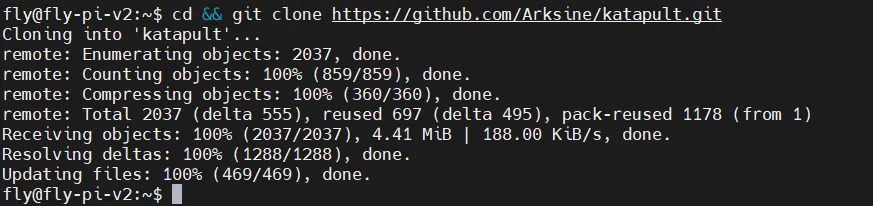
If you are using a non-Fly official host computer, you must execute the following command to install the firmware flashing dependency package!
- GitHub Repository
- Domestic Mirror
cd && git clone https://github.com/Arksine/katapult.git
cd && git clone https://gitee.com/MrCakeFuck/katapult.git
Get Board ID
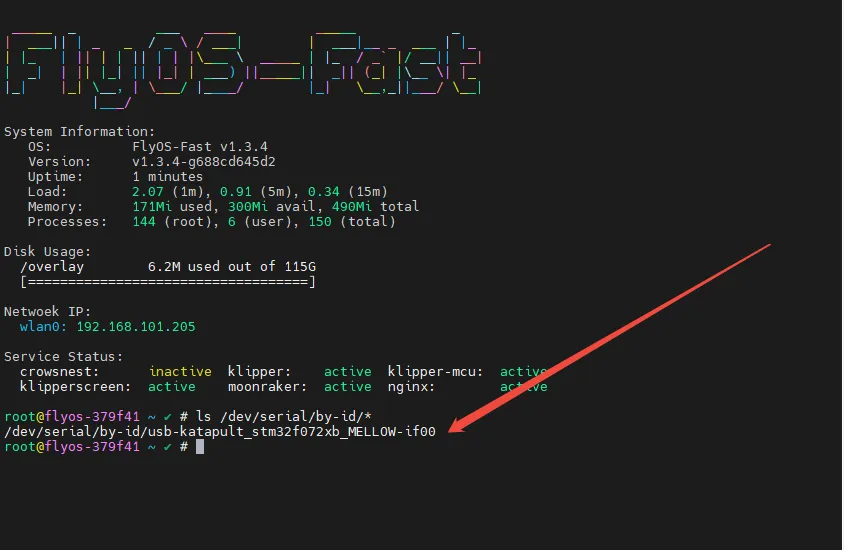
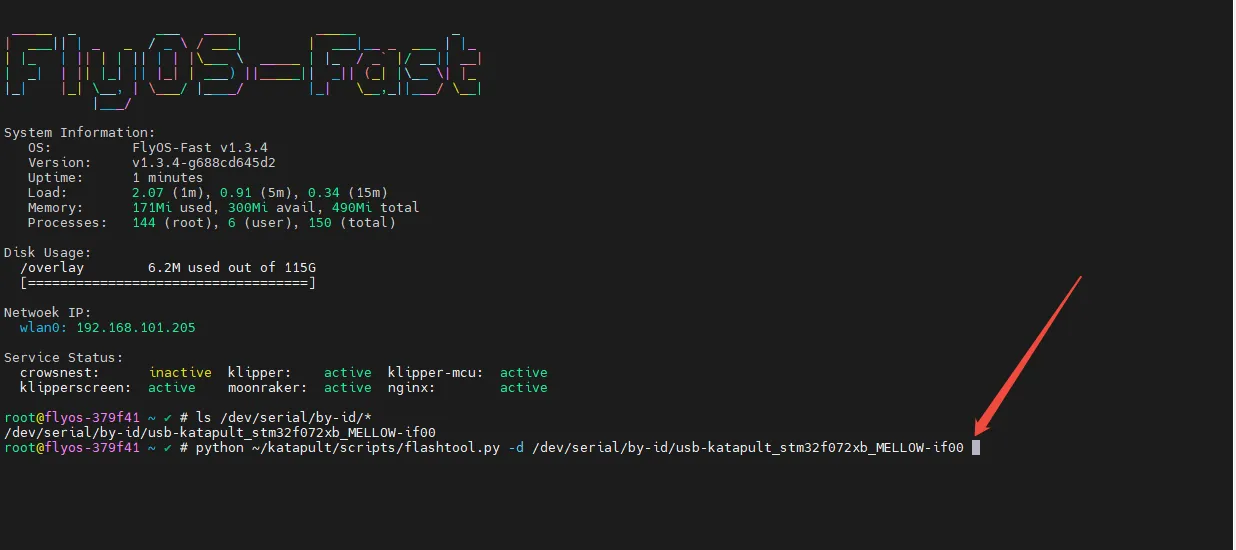
Execute the following command to search for the device ID. Under normal circumstances, an ID similar to the one shown in the image below should be displayed (Note: The ID is different for each board):
ls /dev/serial/by-id/*
Flash Firmware
- Ensure the firmware file has been compiled.
- Replace
<your board ID>in the command below with the actual ID obtained in the previous step.
- Fly-Armbian/Regular Host
- Fly-FAST System
~/klippy-env/bin/python ~/katapult/scripts/flashtool.py -d /dev/serial/by-id/<your board ID>
python ~/katapult/scripts/flashtool.py -d /dev/serial/by-id/<your board ID>
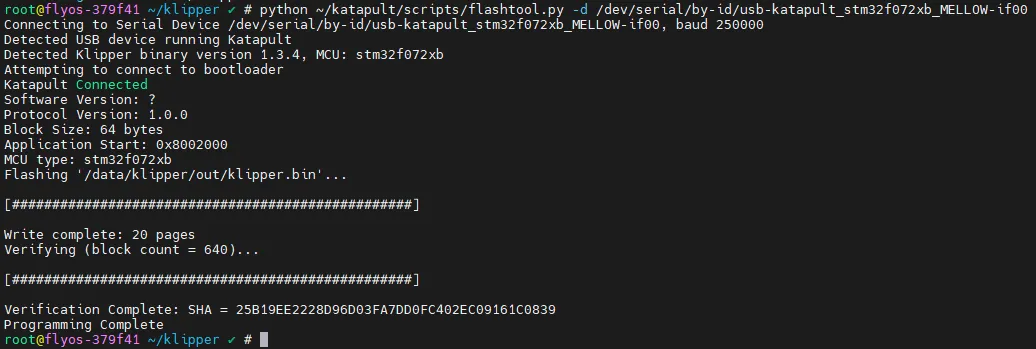
Flashing Process Reference:
Successful Flashing Reference:
Firmware Update
- USB Firmware Update
- Bridged CAN Firmware Update
USB Firmware Update Steps
- Query Board ID
ls /dev/serial/by-id/*
In the image below, /dev/serial/by-id/usb-katapult_rp2040_E662549553642032-if00 is the board ID.

- Update Firmware
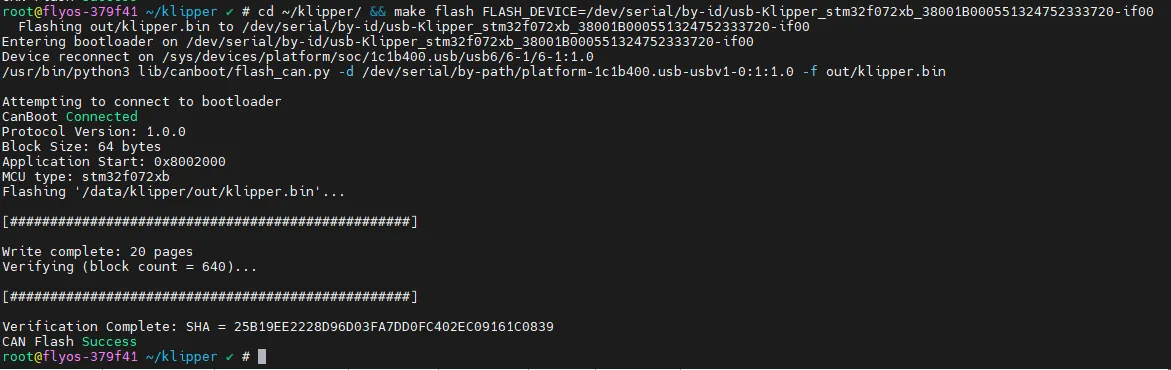
cd ~/klipper/ && make flash FLASH_DEVICE=<your board ID>
- Replace
<your board ID>with the actual ID obtained from the query.
Bridged CAN Firmware Update Steps
- Reset to Enter Flashing Mode
<your board ID> refers to the CANBUS UUID of the board as configured in the printer.cfg file.
- Fly-Armbian/Regular Host
- Fly-FAST System
~/klippy-env/bin/python3 ~/katapult/scripts/flashtool.py -i can0 -r -u <your board ID>
python3 ~/katapult/scripts/flashtool.py -i can0 -r -u <your board ID>
In the image below, f95cee90e1f9 is the board's CANBUS UUID (for example only).

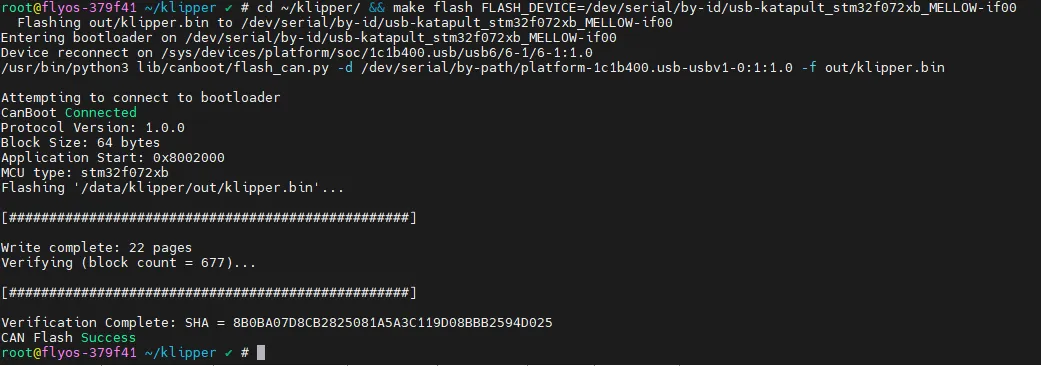
- Query New Device ID
ls /dev/serial/by-id/*
- This is for reference only!
- In the image below,
/dev/serial/by-id/usb-Klipper_stm32f072xb_38001B000551324752333720-if00is the newly identified board ID.
- Flash New Firmware
cd ~/klipper/ && make flash FLASH_DEVICE=<your board ID>
Solutions for Flashing Wrong Firmware
Method 1: Quickly Enter Flashing Mode
- Power off the board.
- After powering on again, quickly double-click the RESET button.
- Re-enter flashing mode.